
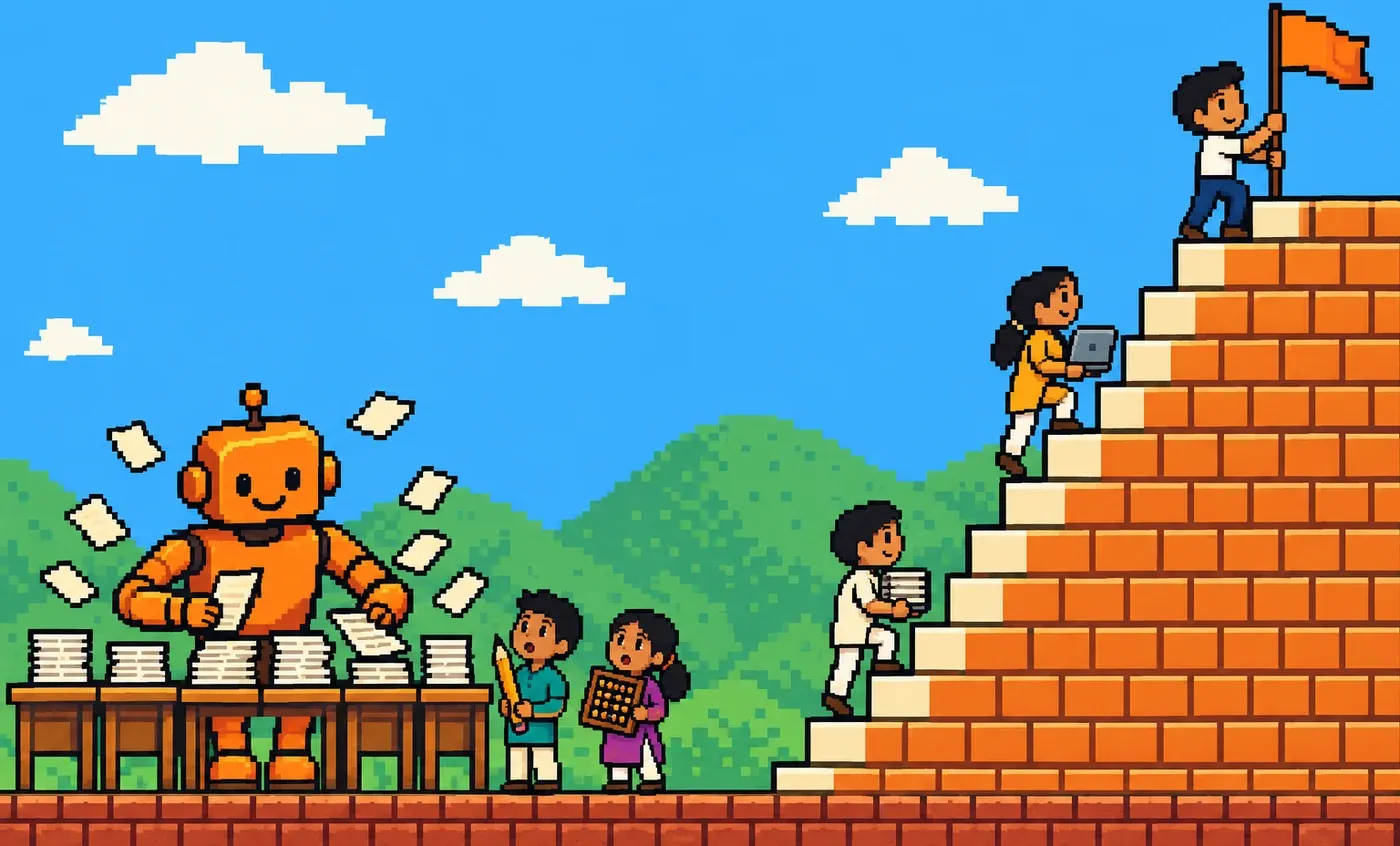
Someone on Reddit asked a question I keep coming back to. If AI replaces all the jobs, where do corporations expect people to earn the money to keep being their customers? Why is nobody asking that?
It is a fair question. Here is my take, explained as simply as I can.
Jobs are not disappearing. Their nature is changing.
Go back to the Industrial Revolution. Most people made money from physical labour, and most of that labour was on farms. It is still happening. In 1991, about 44% of the world’s workers were in agriculture. Today it is about a quarter. In India, close to two in three workers were in agriculture in the early 1990s. Today it is under half. Those jobs still exist. There are just fewer of them, and the rest of the work moved somewhere else.
We are in another one of those shifts. For the last few decades we have lived in a task-based knowledge economy: you are paid to do tasks with your head. That is now changing into an ownership-based, outcome-based economy. You get paid for owning a result, not for doing the steps that lead to it, because the steps are increasingly what AI does.
A fun fact about the word “computer”
The word “computer” is first recorded in 1613, and it meant a person. Someone who computed figures for a living. Human computers did that job well into the 20th century. NASA still employed them in the 1950s. Then electronic computers took the job so completely that we forgot the word ever described a person.
But here is the part people miss. During the Second World War, a group of women at the University of Pennsylvania worked as computers, calculating artillery trajectories by hand. When the Army built ENIAC, one of the first electronic computers, six of those women became its first programmers. The machine took the task. The people who understood the task moved up to running the machine.
That is the pattern. The task goes. The ownership of the task is where the new job is.
So why does it feel like the money is going to a few people?
Because ownership and building are not skills our generation learned in school or college. We were trained to do tasks well and hand them over. Owning an outcome, building something, taking responsibility for whether it works: that does not come naturally to most of us, because we never exercised that skill.
So the people who already have that muscle are capturing most of the value. Power and money are concentrating in fewer hands.
Soon, the most sought-after jobs will be ownership-based and outcome-based. Other jobs will still exist, but there will be fewer of them, pay less, and will be considered less rewarding.
Back to the Reddit question
This is where the question bites. If money concentrates with the people who own things, and owners alone cannot buy enough to keep an economy running, who are the customers?
There is no automatic answer. History did not solve this by itself. It got solved because income found new ways to reach people: new kinds of work, wider ownership, and policy. The same three levers are on the table now. More people owning a piece of what they build, whether through equity, small businesses, or their own products. Some form of redistribution. And new kinds of demand we cannot name yet, the same way nobody in 1900 could have named “app developer”.
Which of those wins is not decided. It depends on choices still being made.
It will get worse before it gets better
During the early Industrial Revolution in Britain, by the economic historian Robert Allen’s count, output per worker rose by nearly half between 1780 and 1840 while real wages barely moved. Economists call it Engels’ pause. Some later work argues the gap was smaller, but nobody argues it did not hurt. Wages did catch up eventually. A generation paid for the wait.
There is one big difference this time: speed. The move off the farms took most of a century. Children could train for jobs their parents never had. This time, this shift may happen inside a single career. That is what makes it scary, and it is also why the transition is where most of the pain will be.
So yes, history is repeating itself. Expect a rough patch: a bubble bursting, a recession, a lot of companies going under.
AI is here to stay. Most AI companies are not.
I think about 90% of AI companies will be wiped out. We have seen this before. In the dot-com crash most internet companies died, and the internet stayed. The same thing will happen here.
What this means for you
If your work is a list of tasks someone hands you, that is the part that is most exposed. The part that stays yours is owning the outcome: deciding what good looks like, building the thing, and being responsible for whether it works.
Nobody taught us that in school. It is not too late to learn it.